Building Other Worlds: The Art of Immersive Stage Design with Jess Elliot
What first drew you to stage design and decor?
Long before working in these spaces professionally, I was attending parties and festivals from a young age, completely fascinated by the worlds being built around the music. Something immersive, temporary and the sense that you had stepped into somewhere entirely separate from everyday life. The stages, the visuals and the decor excited me and contributed to the questions I had of of how these worlds were made. As someone who has always been creative, looking back, it felt natural that over time I would move closer to the people creating those environments, and eventually begin working alongside them, intentionally but also synchronistically due to where I was spending a lot of my time.
What do you want people to feel when they step into a space you have helped create?
For me, the goal is to make people feel as though they are stepping into another world. A curated world. A space inspired by a familiar place, a different decade, or a strange in between space that does not fully belong to any one reference point. You want people to feel grounded in the environment, but also visually transported by it. On a dance floor that feeling might need to be immersive and energising, while in a quieter space it might need to feel softer, slower, and more intimate. What matters is that people don’t feel like detached observers. The strongest spaces are the ones that make you feel included in the production and the environment not just as a visitor, but as part of what’s happening. The space only fully exists once people bring their energy into it.
Why does attention to detail matter so much in immersive design?
That sense of inclusion often comes down to detail. Small things matter. The hidden corner or secret stage that someone discovers by chance. The object that feels as though it was placed there just for the curious few. The texture on a wall, the strange prop in a nook, the handwritten prompt inviting someone to interact with the space. Those details are often what make an environment feel alive. They also help break down the barrier that can sometimes exist between the booth and the dance floor, or between the production itself and the people moving through it. Good design should stimulate people, but it should not make them feel separate from the space they are in. It should invite them in and provide something that feels deeply personal, intuitive and worth exploring.
Where do you feel your strengths lie as a creative?
I think I thrive the most in the details. No matter the scale of the project, I approach every space from the perspective of the attendee. What would they notice first? What would guide them through the space? What would make them pause, feel curious, or feel held by the environment? That perspective shapes how creative ideas are executed. It is not only about what looks impressive or beautiful from a distance. It is about what feels meaningful when you are actually inside it. As much as I like to zoom in when creating, being able to see the wider vision of a space takes a unique perspective that is hugely beneficial in the initial design process. Overall vision and an mwaningful concept is what allows those details to feel intentional rather than decorative.
Which projects have shaped your creative identity the most?
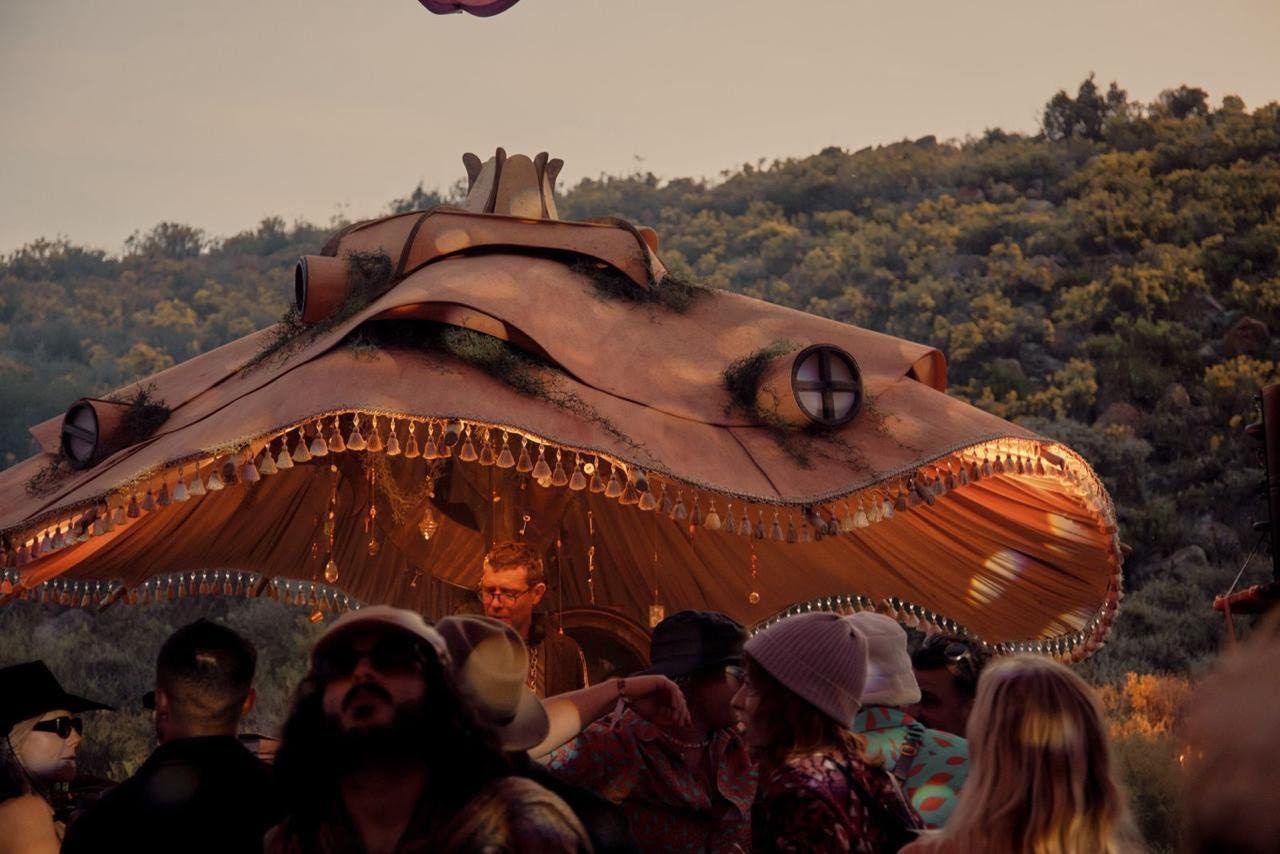
A huge amount of credit in my journey goes to Pangea. Being given so much trust from the founders in the early days was foundational. We started as “decor fairies” sprinkling a feminine touch into the existing spaces, expanding into “The Village” before it became Enigma. Enigma specifically, which I have built alongside my painter/ partner in crime, Hannah (Banana), really became a kind of creative mecca for us. It gave us the platform to pour an almost overwhelming amount of attention into the work. Not only the centre stage itself, but all the smaller spaces around it, each of which could become its own little world. Places designed for interaction, and installations that rewarded those who wandered a bit further. Our ever changing booth’s from a bookshelf filled with trinkets, to a wobbly tasseled mushroom, to an ever evolving Tree of Voices. One of our favourite recurring pieces has been Punky Pink// Mutha of Punk, an old cable car like capsule we found at an old prop house and reimagined each year with a new interior theme. Working within strong physical structures like that unlocked a whole new level of detail and story telling for us. The endless creative contributions that transformed this space and everything in it was thanks to the most committed, skilled, open minded group of talented friends that organically became our core crew.
How does your work in film and graphic design connect to festival production?
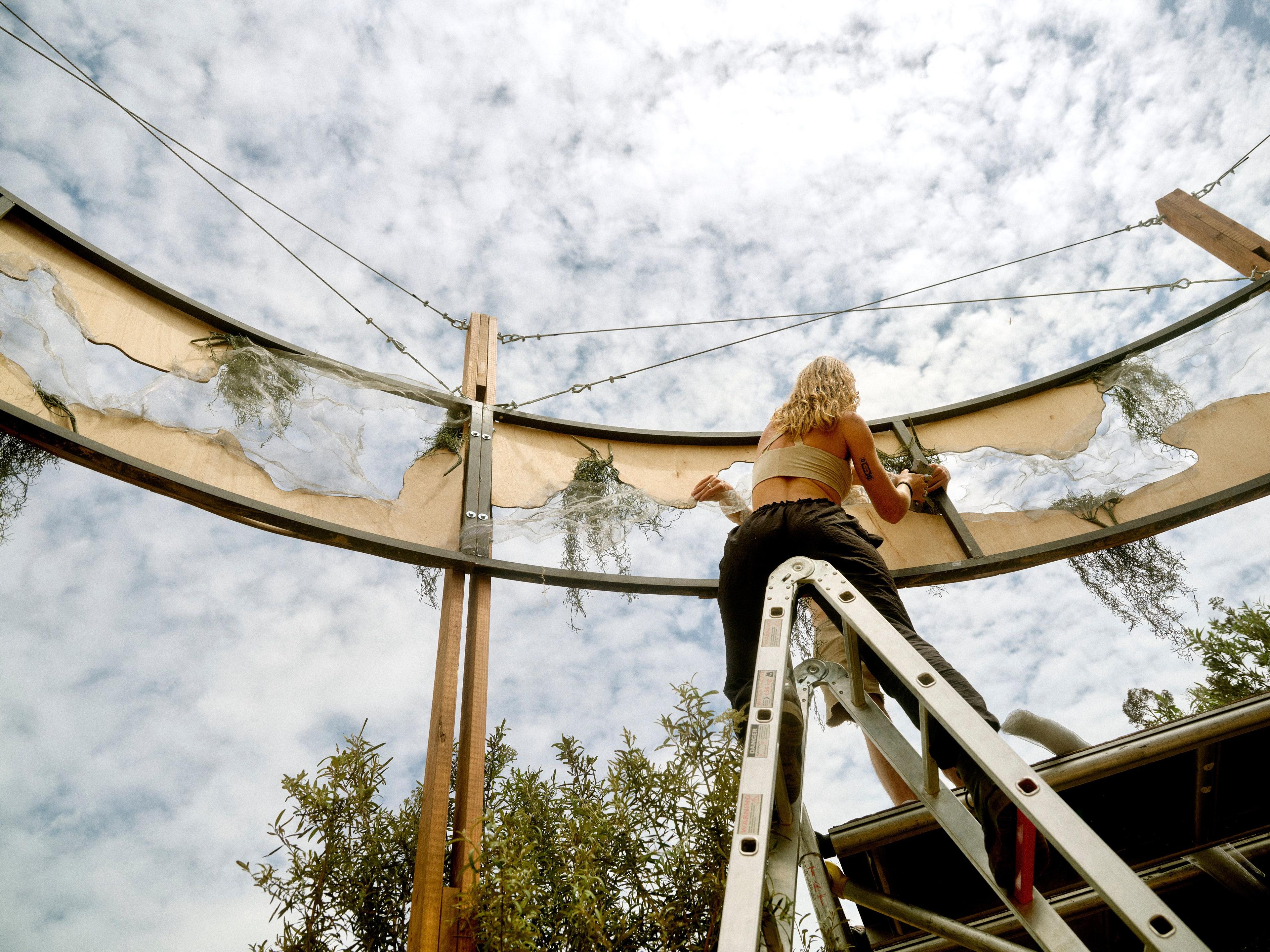
My work outside of festivals has also shaped the way I approach this. I freelance as an illustrator and graphic designer, and work in set dressing and props the film industry, which is deeply connected to this kind of practice. Building a set and building a stage rely on many of the same instincts. Both involve transforming materials into something else entirely. Through set building and scenics, plywood and tiles become a crisp niche bathroom, sticks and hessian become a 3000BC desert market, a wooden facade becomes a mouldy, abandoned concrete wall. In many ways, I entered film because of my experience in festival production, when usually it happens the other way round. Due to that I had a well rounded portfolio and people in film were interested in hiring me precisely because the same eye and skill set translated across.
What was the turning point that expanded your work beyond South Africa?
One of the most pivotal moments in that crossover happened in 2022, when I met Patrick Baumy, the founder of Wanderzirkus Kollectiv in Germany, while he came to lend a hand at Pangea. At first, his invitation seemed casual enough, to help build a stage in Germany, if I happened to be free in June. Later that week he showed me the plans for the Palapa stage at Fusion Festival. A massive dystopian city scape, that could hold up to fifty thousand people and a lineup featuring artists who would play on the stage that we build, such as Stimming, Acid Pauli, and Alice Phoebe Lou. Internally, I was losing my mind. It felt surreal. A few months later I was there, accompanied by painter partner in crime Hannah, expecting to join as a painter and illustrator, only to be introduced instead to the unfamiliar world of scenic painting.
What did you learn from working at Fusion Festival?
Fusion completely reshaped my understanding of what this work could be. The scale alone was something I had never experienced before, ten thousand crew members on site, almost as much as the amount of attendees of our biggest South African festivals. We were taught how to use basic materials and transform them into whatever the world around them needed to be. Promoting a DIY culture, recycling and reusing existing materials, instead of ordering new prefabricated parts. We learnt how to create real life textures you see in moss, rust, chalk, copper oxide, bricks, peeling paint, graffiti… Through specific combinations of paint, glue, water, sawdust, and other materials, we created effects that looked weathered, aged, dirty and abandoned to encapsulate this strong concept driven stage to become a dystopian city made up of painted facades. The head of paint Kiara Watermeyer who taught us these skills, was also South African, which made it all the more grounding to learn in such a strange and intense environment alongside someone from home. I really owe so much to her, Lou and Anna for teaching me all the techniques I still use to this day. One of my favourite parts of working on this stage was the Palapa language, created by a previous member of the team, each letter, a symbol and the only typography used within the graffiti, the shop signs and the visuals around the space. Hannah and i became fluent in writing this language and would hide hidden messages in the walls. I spent a month and a half at Fusion, and in that time, I learned an enormous amount. It was one of those experiences that marks a clear before and after. The following year, I was invited back to co-lead the paint team. It made me realise that when you dedicate enough time to learning a skill, you build trust within it. And with that trust, came the opportunity to share it, teach it, and to pass it on. I learned far more than just technique. Through trial, error, and experience, my confidence grew, making it easier to step into similar roles back home.
How has your relationship with this work changed as you have grown?
Since then, I have been working at Waking Life, building a space called the Nest, using natural materials and eucalyptus bark, lead by, Thomas Ott, who I met during the Palapa build in 2022. Another space that has been hugely formative and has deepened my appreciation for working with softness, patience and nature. The younger version of myself wanted to do everything, every build, every festival, every opportunity. From Germany to Poland to the UK circuit, I experienced that fully. Sleeping in tents, vans, welding containers, from trains to buses to planes, leaving one festival the day it ended to arriving at another build the same evening, spending very little time in cities and most of the time on site. Meeting new characters, stages, techniques, aesthetics. It honestly felt like time travel and in those years it was the world I thrived most in. But I am at a point now where I’m more conscious of where my energy goes. These worlds are ever inspiring and exhilarating, but they can also be intense. So a big part of growth for me has been learning how to choose, how to identify with what feels aligned, and how to commit fully to that, rather than trying to be everywhere at once.
What has this creative path taught you about the kind of life you want to live?
This work is as much about people as it is about output. The people I’ve met along the way have made these experiences incredibly profound, expanding my perspective on life and the many ways it can be lived. On large international builds, you’re living and creating alongside crews from all over the world, from different cultures, backgrounds and ways of thinking. You become a part of the world you’re helping build. In those environments, you learn how to communicate beyond language barriers. You teach each other through showing, through an unspoken understanding that emerges through craft. It shifts how you relate to people beyond first impressions. Being part of something like this has made me reflect on what it means to live creatively, and whether the life I’m building feels aligned and in service of a bigger picture. I have (at times) felt pressure and expectation to follow a more conventional path. I’ve questioned whether I should have used my animation degree, or done something more predictable or recognisable. But when I acknowledge how expansive it has been and how closely it reflects the way I want to move through the world it’s felt right. The way we live and create within our immediate circles has a direct impact. There’s a kind of influence in encouraging change simply through how we show up, collaborate, and choose to build our lives.
What has made this unconventional career path feel worthwhile?
The past few years have brought people into my life who feel like soul family. Not just collaborators you meet on a build, but connections that extend beyond the festival and into shared creative spaces. These are not just people to imagine with, to build temporary worlds with, but also people who collectively reshape ways of thinking, challenge societal structures, and contribute to a sense of newness and positive change. It’s made me deeply grateful for this unconventional way of living. Especially in the context of everything happening in the world, there’s something really moving about being part of a culture where creation is valued for its own sake. Creation stands in contrast to consumption. To make something simply because it should exist, because it moves people, because it opens new ways of experiencing life. That, to me, feels quietly radical.
How do you make a creative life financially sustainable?
The reality is that this path can be slow. Many people in these spaces begin by volunteering or working for free before paid opportunities start to open up. It takes time. But working overseas helped to make that life sustainable. The German circuit in particular was strong in terms of opportunities to take on lead roles and get paid well and that gave me a degree of financial stability. At home, film work, set work and illustration help balance things out. Living in build environments for long periods can be taxing, and I want to continue finding ways to sustain myself creatively that are not dependent on always being physically present. One of the things I am especially interested in moving toward is doing more concept design work, developing the stage in its early phases, building the visual language, and then handing that vision over. I’m currently designing the main stage for Moments Festival in Germany even though I cannot be there in person. This kind of background work feels really exciting, because it opens up another way of participating.
Why is lighting such an important part of stage design?
Lighting has also become one of the most interesting learning curves in all of this. It is one of the most important elements of any stage. At larger festivals, there is sometimes a disconnect where the stage build is completed and then lighting comes in later and works somewhat separately. It’s been a priority to make sure that there is intentional dialogue between those worlds from the start. I have close friends working in lighting who have grown in their craft and have started companies, close friends like Amith with Lightcode and Jackson with Resonance. These conversations now happen earlier and more naturally. We talk about mood, rhythm, tone, and how lighting and design can support one another rather than being treated as separate departments. What materials to use that will reflect, bounce and integrate the lighting. That makes a huge difference. Lighting asks many of the same questions that decor does. How do you want people to feel? What kind of energy should the space hold? In some cases, lighting can shape mood even more strongly than decor can, but when the two are developed together, the result is a far more cohesive and powerful environment.
How do opportunities in South Africa usually come about?
Within South Africa, most opportunities still come through word of mouth, and physically meeting people, well at least that’s been my experience. They arrive through referrals, through WhatsApps, through someone passing your name on because they know your work and trust your eye. That is one thing I genuinely love about the scene here. Cape Town is small enough that people tend to know what one another are doing which starts conversations, ideas start to seed and collaborations emerge. There are more and more people wanting to get into festival builds and beginning to realise that it can be a sustainable and fulfilling path.
What makes Cape Town’s creative scene so exciting right now?
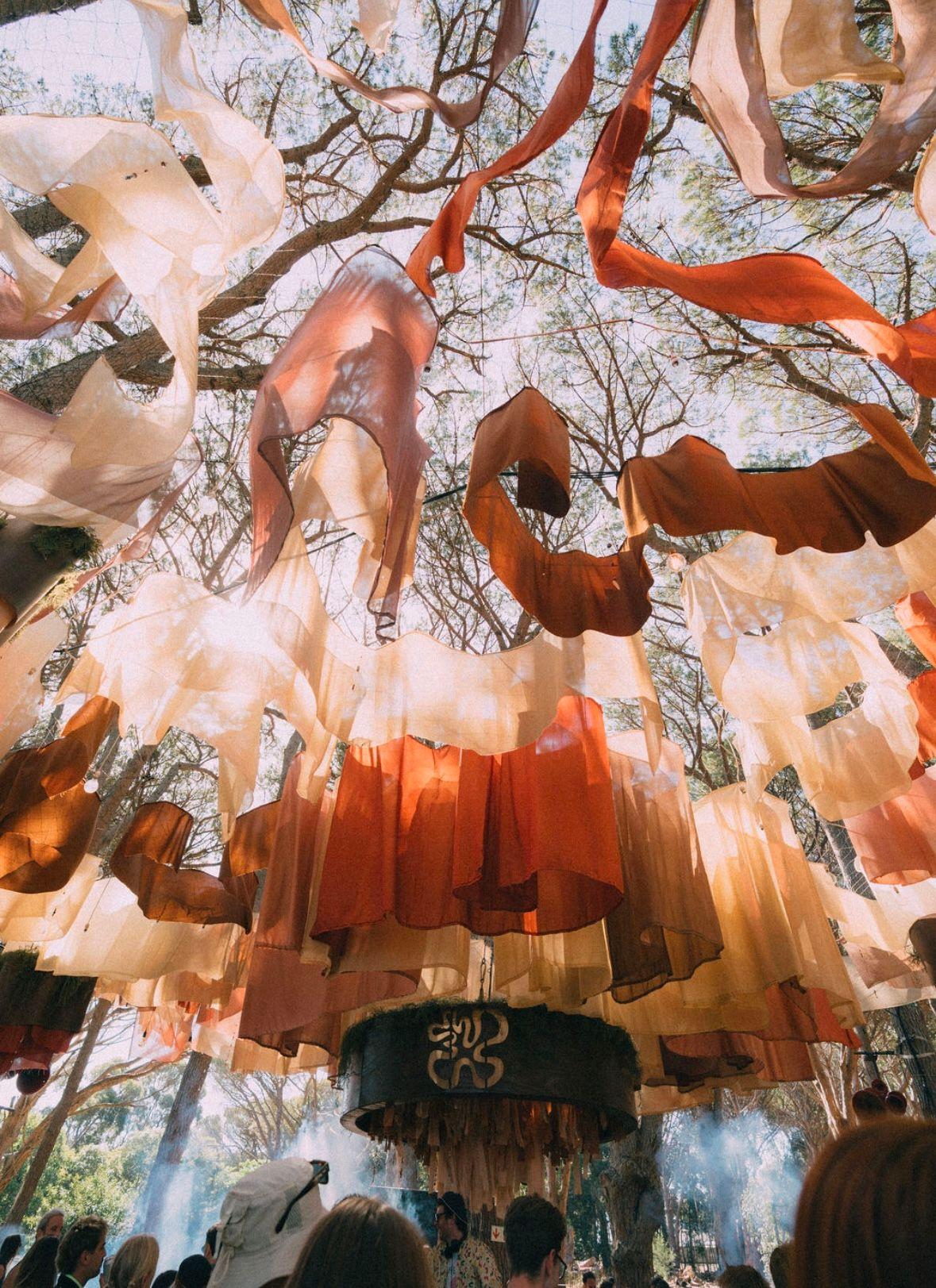
I genuinely believe there is an extraordinary amount of creative talent in South Africa. I’ve been planting the seed to start a collective with all the creatives in our extended community who could pitch directly into events rather than waiting to be hired into someone else’s concept, because we have enough hands and definitely the combined skills. That idea still excites me, because it would allow the creative direction to come more fully from the people with deep experience in these spaces, rather than being handed down from elsewhere. I think a lot of us feel that urge, to take more initiative, to trust our own creative authority more fully. And the truth is, what is being made here in Cape Town is world class. That is something I have realised properly in recent years, and keep realising from observing and being a part of the spaces being made now. The bar is set and people are listening and I had this realisation again whilst building the main stage at Kunda Valley. For a long time I put other countries and scenes on a pedestal, but I don’t feel that way anymore. What we are building here is truly exceptional with a sincere nod to the incredible pool of musical talent that is at the core of it all.
What advice would you give to someone wanting to enter this world?
If I had to offer advice to anyone wanting to enter this world, it would be to stay open. There is so much to learn from the people around you, and it is very easy to box yourself in too early by calling yourself one kind of creative. You may think you are only a painter, only a constructor, only a “decor fairy”, then one project can teach you a completely new skill that expands your whole practice. That multidisciplinarity makes you far more valuable, but more than that, it keeps the work alive. Ask questions. Stay curious. Learn from talented people. Let yourself grow in more than one direction. Growth happens when you’re surrounded by people who challenge and expand you.
How do you avoid burning out in a world that moves so intensely?
I would say, pace yourself. Build seasons can stretch for months, and it is easy to throw yourself into everything. But there is real value in choosing more carefully, creating more uniquely, coming up with new ideas instead of repeating ones that have come before. In finding what aligns most strongly, and then committing deeply to that rather than spreading yourself too thin. Not every opportunity needs to be yours. The right ones will ask enough of you on their own.
What does a well curated dance floor or festival space feel like?
The best ones feel embodied. Even when the energy is chaotic, it doesn’t feel overwhelming. Everything feels like it is moving, breathing, flowing. The space itself gives you permission to express yourself fully. Internally and outwardly. The music acts as a golden thread running through it all, connecting everyone in the space through the same sound, even as each person experiences it differently. In a well held environment, you feel both entirely yourself and completely part of something larger. You feel that there is room for every kind of expression. That permission, to be, to move, to feel, to enter a flow state and share it with others, is maybe what so many of us search for all the time. And when a space manages to hold that, even for a brief amount of time, it stays with you long after the festival ends and I think that’s what it is about. Building and practicing ways of being that don’t demand anything other than allowing yourself to be fully present.