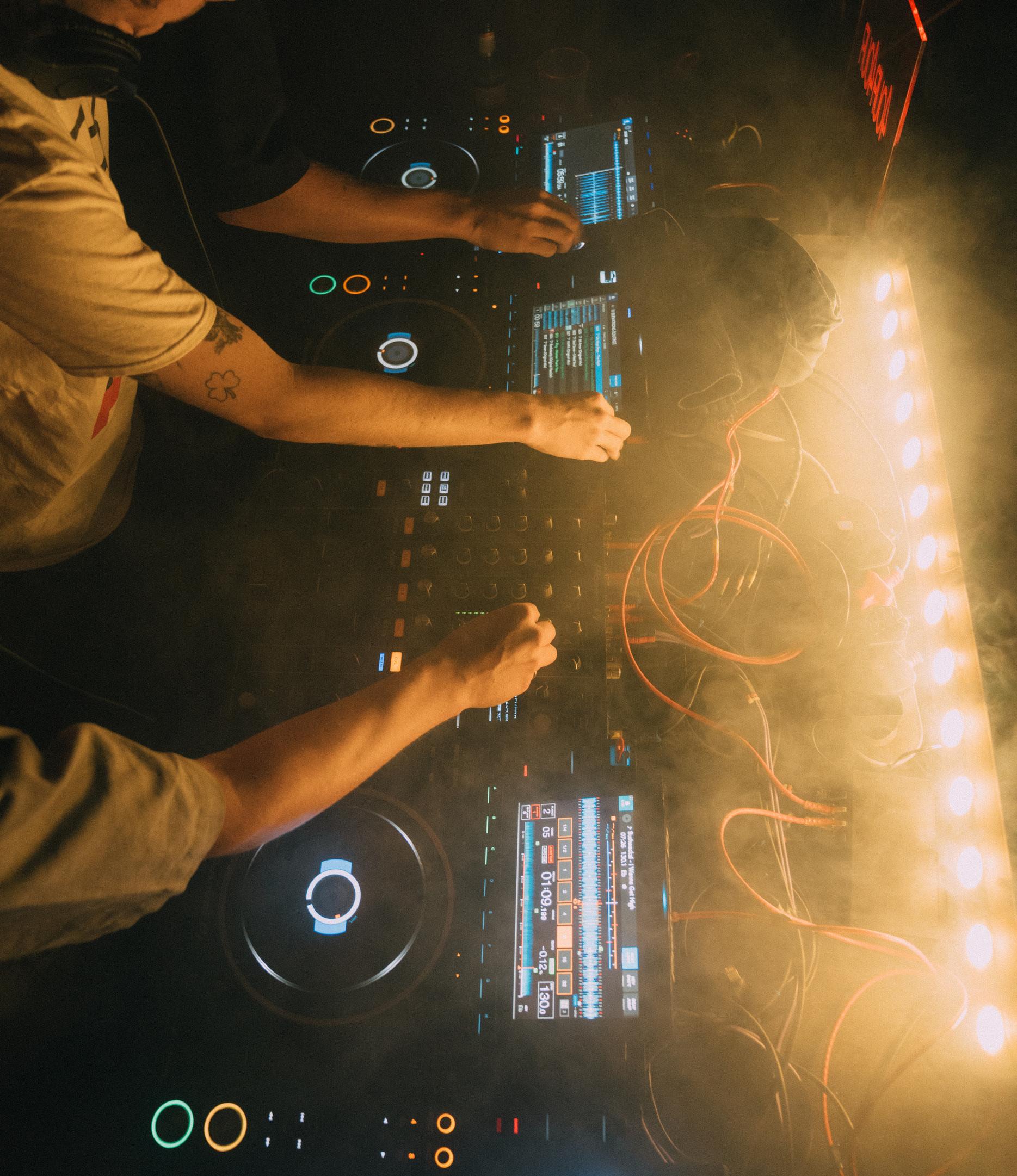
In simple terms, a B2B (back-to-back) refers to two DJs sharing a set, taking turns to select and mix tracks. In practice however, it feels like something far more layered and complex: a live negotiation between taste and instinct. The format isn’t new. Early DJs would swap records out of necessity - sharing equipment, stretching sets, and building community.
That spirit still sits at the core of the B2B today. Even as it’s scaled to mainstages at some of the biggest events in the world, the essence hasn’t changed: collaboration over control.
A good B2B doesn’t sound like two sets stitched together. It feels more like a dialogue. Each DJ reacts in real time - sometimes matching energy, sometimes deliberately shifting it. The best pairings blur authorship entirely, creating moments neither artist would land on alone. The potential for more than one style, put together in one booth, with an abundance of different potential outcomes. That unpredictability is the point. Unlike solo sets, where control is total, B2Bs force DJs to give something up. For some DJs, that’s exactly where the appeal lies. For others, it introduces a level of risk that can be uncomfortable.
From the audience’s perspective, there’s something quite engaging about a good B2B. We’re listening to a set unfold shaped by two unique perspectives. Because of that, it often feels less predictable, and in many ways, it can feel more alive. When it really works, you can feel the difference in energy.
Transitions become less obvious, directions shift more freely, and moments land harder because they weren’t inevitable. Most importantly, it creates something that’s difficult to replicate. Even with the same two DJs, the outcome is rarely the same twice.
That being said, while B2Bs feel spontaneous, they don’t exist without some kind of structure - even if it’s often unspoken. There are certain things that just seem to matter: not cutting tracks too early, not forcing direction, and not treating the set like it’s your own with someone else standing next to you. It should feel like a shared expression, where both DJs can respond to the energy of the dance floor and to each other.
Timing matters just as much as taste. Knowing when to step in (and when not to) can create a fluid exchange. Then there’s the communication aspect. Not always verbal, but constant: eye contact, cues, instinct. Without it, even the best track selection can fall short.
Mistakes happen - rough transitions or unexpected clashes, but they don’t have to define the experience. In fact, the myth of the “perfect set” doesn’t survive long in a B2B. What sticks is the energy: the tracks that land, the risks that pay off, the moment the crowd locks in. In our opinion, it is this ‘looseness’ that is such a big part of the appeal.
As someone on the dancefloor, it is such a great experience to watch and listen to two (or more) DJs having fun together behind the decks. It shifts the focus away from perfection and towards momentum, and it often just feels very human and alive. When a B2B clicks, it’s obvious. The handovers feel natural. The pacing builds without being forced. Tracks don’t compete, they connect.
It becomes less about who played what, and more about the shared direction of the set.
Beyond what the crowd experiences, there’s also something interesting happening for the DJs themselves. B2Bs seem to disrupt routine. Most DJs develop habits over time: go-to transitions, familiar tracks, predictable pacing. Playing with someone else forces you out of that. You have to react instead of plan, listen instead of lead. You don’t always have the luxury of long blends or perfectly phrased transitions. You need to adapt quickly, recover cleanly, and stay locked into whatever direction the set is moving in.
There’s also the way it expands taste. Playing alongside someone with a different approach can highlight things you might not have considered - how they build energy, how they resolve tension, how they take risks. It’s not about imitation, but more about influence in real time.
And maybe one of the more overlooked aspects is restraint. Knowing when not to play your biggest track, when to support rather than shift the direction, when to let a moment breathe. These are decisions that feel very different when you’re not the only one in control.
Images by Diary of Ross